


For many women, pregnancy and motherhood are framed as seasons where fatigue, brain fog, hair changes, weight shifts, and mood shifts are simply part of the experience, something to expect, tolerate, and push through. Something that is labeled “aging”.
But clinically, that narrative deserves to be challenged.

Across preconception, pregnancy, and postpartum, and beyond, women are often undernourished during their most physiologically demanding life stages. The symptoms that arise- low energy, cognitive fog, hair loss, mood changes—are frequently brushed off as “normal,” when in reality they are common signs of nutritional depletion.
Prenatal supplements are meant to help bridge nutritional gaps. Yet emerging data suggest that for many women, they are not doing enough.
The Overlooked Reality of Nutrient Depletion
Large-scale national health data paints a sobering picture.
Even among women who regularly take supplements, nutrient insufficiencies remain widespread. According to NHANES data, common shortfalls include fat-soluble vitamins such as A, D, E, and K, several B vitamins, including B6, as well as minerals like choline, calcium, magnesium, iron, and zinc.
These nutrients are not optional. They are foundational for carrying out essential functions, including:
- Normal hormone signaling and endocrine balance

- Cellular energy production and metabolic demand
- Supporting healthy blood pressure already within a normal range
- Baby’s brain and cognitive development
When these foundations are under-supported, the body compensates, often quietly at first, until symptoms become harder to ignore.
This is particularly concerning because of what you just learned, nutritional depletion appears to affect the vast majority of women, even those who are doing “everything right,” including taking a prenatal.
Why Most Prenatals Don’t Meet Real-World Needs
1. They’re Built on Bare Minimums
Most conventional prenatal vitamins are designed around the Recommended Dietary Allowances (RDAs). These benchmarks were created to prevent outright deficiency- not to support optimal function, resilience, or replenishment during periods of increased demand. Additionally, pregnant and breastfeeding women were excluded from 83% of the studies informing DRIs/RDAs.
As a result, many prenatals provide:
- Minimal dosing rather than clinically meaningful levels
- Less-than-ideal nutrient forms that impact absorption
- Little consideration for the cumulative demands of preconception, pregnancy, and postpartum
Meeting a minimum requirement does not necessarily mean the body is well supported. As a clinician, I am also looking for optimal levels, not minimums.

2. Increased Needs Aren’t Adequately Addressed
Pregnancy and postpartum dramatically increase nutritional demand, yet most standard prenatals do not adjust for:
- Higher nutrient turnover
- Pre-existing depletion
- Stress physiology and metabolic load
- Ongoing demands beyond delivery
This gap helps explain why so many women continue to feel depleted even while supplementing.
Why RDAs Miss the Mark
It’s also important to understand why current standards fall short.
Pregnant and breastfeeding women were excluded from the majority of studies used to establish Dietary Reference Intakes (DRIs/RDAs). As a result, these benchmarks define the lowest intake needed to avoid deficiency, not the intake required to support optimal health across the full reproductive lifespan and beyond.
This means today’s standards do not accurately reflect the real nutritional needs across what Needed refers to as The Motherspan™– from preconception through postpartum and beyond.
When guidelines are built on incomplete data, supplementation based solely on those numbers will inevitably underdeliver, leaving women as the ones to pay the price.
What to Look for Instead

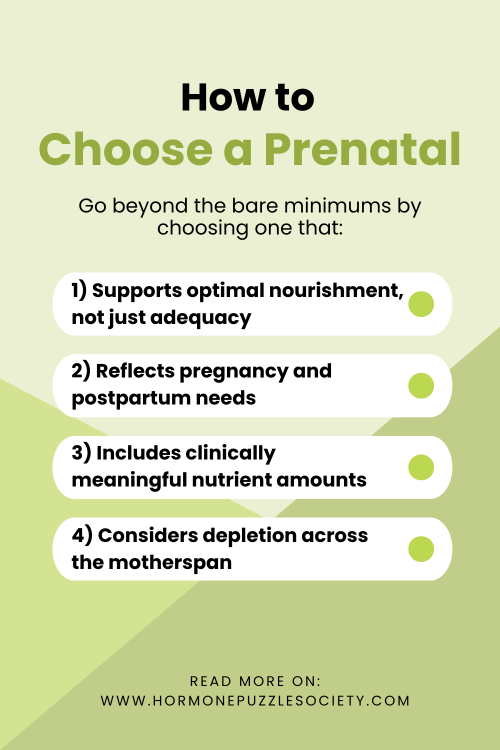
A high-quality prenatal should be designed with nutrient repletion and optimization in mind, not just adequacy.
That includes:
- Key vitamins and minerals in optimal forms and clinically informed amounts
- Inclusion of nutrients is often underrepresented or omitted altogether
- Third-party testing to verify quality and purity
- A format that is practical and easy to take consistently
From a formulation standpoint, not all prenatals deliver the same level of nutritional support. When comparing total daily nutrient amounts, some options provide substantially more nutrition than conventional products. For example, Needed Prenatal Multi delivers eight times more total nutrition than leading prenatal brands, based on total daily nutrient amounts compared using IRI sales data as of December 2025. It provides essential nutrients every woman on a preconception journey needs.
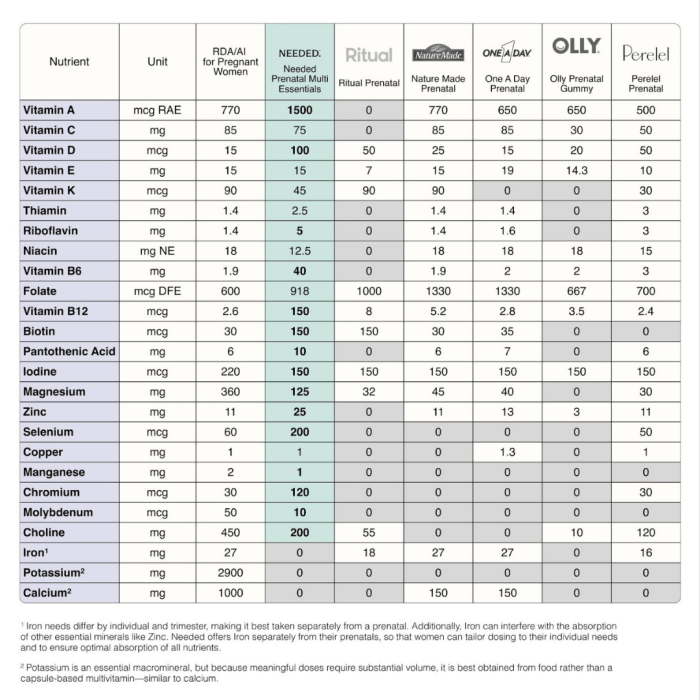
Looking beyond totals, the differences become even more meaningful. This prenatal provides significantly higher amounts of nutrients that are critical during this life stage, yet frequently underdosed—or missing entirely—in mainstream products. This includes choline, several B vitamins, vitamin D, vitamin A, zinc, and trace minerals like selenium and chromium. These choices reflect a strategy focused on addressing depletion rather than relying on outdated minimums.
From a clinical perspective, this is also where formulation philosophy matters. This prenatal is designed using dosing informed by 630 research studies, with the goal of supporting nutrient status in ways standard prenatals often fail to do. It is built to address the widespread depletion seen in modern mothers, not simply to meet baseline requirements.
It also considers the full continuum—from preconception through pregnancy, postpartum, and beyond—rather than treating pregnancy as a standalone event.
Certain ingredients are intentionally excluded for thoughtful reasons. Iron is not included because iron needs vary significantly and are best personalized based on lab work. Omega-3s are also excluded to help preserve freshness and potency, allowing them to be taken separately and dosed more precisely based on individual preference and needs.
Quality and integrity matter as well. Each batch is third-party tested, meets rigorous purity standards, and reflects commitments to transparency, sustainability, and responsible sourcing, details that are often overlooked but deeply important when choosing a supplement during this stage of life.
From a practical standpoint, optimal dosing also translates into a better cost-per-nutrient value over time, particularly when consistency and long-term use are considered.

From a practitioner perspective, this is why I recommend Needed Prenatal Multi, and Needed’s full line of preconception, pregnancy, and postpartum products to all my clients. These formulations prioritize optimally dosed, bioavailable nutrients that support true nourishment—not just meeting minimum requirements or checking marketing boxes. This philosophy is also why Needed is trusted by over 15,000 practitioners: the focus is on meaningful nutrition that supports the body’s increased demands, rather than simply avoiding deficiency.
Another important piece of this puzzle, which I’ve discussed in a previous guidebook, is gut health. If the gut is compromised, absorbing nutrients—even from a high-quality prenatal—can be challenging. I encourage you to read this guidebook to better understand holistic gut-healing practices and why they matter for overall health and fertility. My hope is that by investing in a high-quality prenatal, such as Needed Prenatal Multi, you are not only taking the supplement but truly absorbing the nutrients and receiving the maximum benefit from it.
The Bottom Line
Prenatal vitamins should not be about doing the bare minimum.
They should reflect the reality that women often enter pregnancy already depleted, face increasing physiological demands, and deserve support that aligns with modern research,not outdated standards.
When choosing a prenatal, the most important question isn’t whether it meets RDAs; it’s whether it truly supports the body during one of the most critical seasons of life and does it provide optimal levels of its ingredients or just the bare minimum.
Because “normal” symptoms aren’t always normal. and adequacy is not the same as optimal nourishment.
Written by:

Dr. Kela Smith, Ph.D., DNM
Fertility and Hormone Expert
The Hormone Puzzle Society™
www.hormonepuzzlesociety.com
This blog/post is sponsored by Needed, a brand I genuinely recommend to my patients and use personally and have since they were founded in 2017.
These statements have not been evaluated by the Food and Drug Administration. This product is not intended to diagnose, treat, cure, or prevent any disease.
To learn more or to purchase the product, visit – https://thisisneeded.com/products/prenatal-multi-essentials.
To learn more about my services or to book a telehealth appointment visit www.hormonepuzzlesociety.com.
- For the NHANES data on common deficiencies: https://pubmed.ncbi.nlm.nih.gov/31225890/
- For the statistics on pregnant/nursing women excluded from the research: https://www.science.org/doi/10.1126/sciadv.abj8016
- Parisi F, et al. Micronutrient supplementation in pregnancy: Who, what, where and why. Journal of Maternal-Fetal and Neonatal Medicine. 2018;31(12):1626-1635. PMC6416688. PMC
- Gernand AD, et al. Micronutrient deficiencies in pregnancy worldwide: health effects and preventive strategies. Paediatric and Perinatal Epidemiology. 2016;30(3):256-275. PMC4927329. PMC
- Adams JB, et al. Evidence-based recommendations for an optimal prenatal supplement: a comprehensive review of current literature and prenatal formulations. Maternal Health, Neonatology and Perinatology. 2022;8:9. PMC9275129. PMC
- Keats EC, Haider BA, Tam E, Bhutta ZA. Multiple micronutrient supplementation during pregnancy. Cochrane Database of Systematic Reviews. 2019;3:CD004905. (WHO summary and systematic evidence synthesis) World Health Organization
- Dymek A, et al. Choline — An underappreciated component of a mother-to-be’s nutritional needs: implications for fetal development and maternal health. Nutrients. 2024;16(11):1767.