

If you are experiencing pregnancy after miscarriage anxiety, you are not overreacting, broken, or doing pregnancy “wrong.”
For many women, getting pregnant again after a loss does not automatically bring peace. Even when scans look good, labs are normal, and everything appears reassuring on paper, your body may still feel on edge. You may find yourself waiting for bad news, checking symptoms constantly, or feeling like you cannot fully exhale.
That response makes sense.
After miscarriage, your mind and body often remember what happened, even when you deeply want to feel hopeful again. And if you have also walked through infertility, the emotional load can feel even heavier.
The good news is that there are gentle, practical ways to support yourself. You do not need to force positivity. You do not need to pretend you are not scared. And you do not need to do this alone.

Why pregnancy after miscarriage can feel so anxiety-provoking
Pregnancy after loss can feel uniquely vulnerable because your previous experience changed the way your body interprets uncertainty.
Before loss, pregnancy may have felt exciting. After loss, pregnancy can feel like a place where something painful happened. Even if this is a different baby and a different pregnancy, your nervous system may still react as if danger is near.
This can show up as:
- Constant worry or dread
- Fear that something has gone wrong between appointments
- Trouble sleeping
- Feeling jittery or on edge
- An exaggerated startle response
- Difficulty relaxing, even when you want to
- Reassurance-seeking through Googling or symptom checking
Many women describe being pregnant after miscarriage as “holding their breath” for weeks or months. That emotional tension is common, especially in early pregnancy after miscarriage, when things may still feel uncertain.
Is anxiety in pregnancy after loss normal?
Yes. Anxiety after miscarriage is common.
That does not mean it feels easy, and it does not mean you should ignore it. But it does mean your feelings are understandable.
Loss can leave behind grief, fear, disappointment, and a deep sense that your body is no longer a place you fully trust. When you become pregnant again, those feelings may rise to the surface quickly.
You might feel:
- Hopeful and terrified
- Grateful and grieving
- Excited and disconnected
- Relieved and still deeply cautious
These emotions can coexist. You do not have to choose one.
One of the kindest things you can do for yourself is release the idea that you should only feel happy. Pregnancy after loss often includes both joy and fear. Allowing space for both can reduce the pressure you put on yourself.
Common signs your nervous system feels stuck on high alert
When your nervous system is activated, your body may behave as if it needs to stay alert at all times.
That can make pregnancy after loss anxiety feel physical, not just emotional.
You may notice:
- Tight shoulders or jaw clenching
- Racing thoughts
- A hard time settling down at night
- Feeling unsafe even after a reassuring ultrasound
- Needing constant reassurance from others
- Increased sensitivity to conversations, social media, or pregnancy triggers
Some women also notice that when stress is high, everyday pregnancy symptoms feel harder to manage. While not every symptom is caused by anxiety, it is true that chronic stress can make your body feel more overwhelmed.
Instead of asking, “Why can’t I just relax?” it can be more helpful to ask, “What does my body need to feel a little more safe right now?”
How to cope with pregnancy after miscarriage anxiety
Coping does not mean eliminating fear completely. It means building steadiness, safety, and support in the middle of uncertainty.
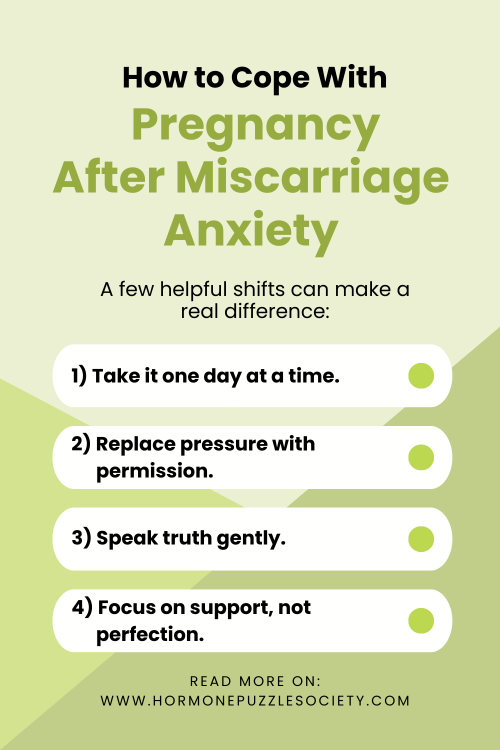
A few helpful shifts can make a real difference:
1. Take it one day at a time. Try not to mentally live in the future all day. Bring yourself back to today, this moment, this breath.
2. Replace pressure with permission. Give yourself permission to feel what you feel. You do not need to “perform” calmness.
3. Speak truth gently. Fear is loud, but it is not always accurate. Try simple truths like:
- Right now, I am pregnant.
- Right now, I am safe.
- Right now, I have support.
- This is a different pregnancy with a different baby.
4. Focus on support, not perfection. You do not need the perfect mindset, routine, or diet. You need consistent care.
Regulate before you research: what to do before Googling symptoms
One of the most practical tools for managing anxiety after miscarriage is this: regulate before you research.
When fear spikes, many women go straight to Google. That is understandable. You want reassurance. You want answers. You want control.
But researching while you are already in panic mode can intensify fear.
Before opening your browser or scrolling forums, pause and do this first:
- Put both feet on the floor
- Drop your shoulders
- Unclench your jaw
- Take a few slow breaths
- Remind yourself: “In this moment, I am safe.”
Even 30 to 60 seconds of grounding can help you approach the next step from a more regulated place.
This does not mean you should never contact your provider or ask questions. It simply means your body deserves support before you seek more information.

Grounding techniques to calm your body in the moment
When you are pregnant after miscarriage and scared, simple grounding can help bring you back to the present.
A few helpful techniques:
1. Use the 5-4 method
- Name five things you can see.
- Name four things you can hear.
This helps shift your brain out of spiraling thoughts and back into your actual surroundings.
2. Orient yourself to the room
Say to yourself:
- I am sitting in a chair.
- My feet are on the floor.
- I am in my home.
- Right now, I am safe.
3. Soften physical tension
Notice where you are bracing:
- Jaw
- Shoulders
- Belly
- Pelvic floor
- Hands
Then gently release what you can.
4. Use warmth
A warm blanket, warm bath, or heating pad on a non-pregnancy area can feel comforting and help your body settle.
These are small tools, but small tools matter. You do not need a complicated routine for your nervous system to feel supported.
Daily habits that support emotional steadiness after loss
The goal is not perfection. The goal is stability.
When your body is under stress, consistent basics can help create more emotional steadiness.
Try focusing on these habits:
1. Eat for stability, not perfection
Skipping meals can make anxiety feel worse. Aim for regular meals and snacks with a balance of protein, healthy fats, and carbohydrates.
2. Create one supportive rhythm
Choose one daily anchor, such as:
- Going to bed around the same time
- Taking a short walk
- Doing a morning check-in
- Reading something calming
- Repeating a gentle truth statement
3. Rebuild trust with your body
If you feel disconnected from your body after loss, start small. Notice what your body is doing well today.
You might remind yourself:
- My body carried me through the night.
- My heart is beating.
- My lungs are breathing.
- My body is worthy of support.
That kind of practice can slowly shift your relationship with your body from frustration to partnership.
How to set boundaries with family, friends, and pregnancy triggers
Boundaries are not selfish. They are supportive.
In pregnancy after loss, even well-meaning comments or gestures can feel overwhelming. Family members may ask too many questions. Friends may offer advice you did not ask for. Social media may leave you spiraling.
Consider boundaries like:
- “I’m not ready to talk about that yet.”
- “Please check with me before sending pregnancy content.”
- “We’re taking this one day at a time.”
- “I appreciate your excitement, but I need to go slowly.”
You are allowed to protect your peace.
You are also allowed to limit exposure to triggers, whether that means muting accounts, stepping back from certain conversations, or declining events that feel too heavy right now.
Creating emotional sanctuary matters.
When anxiety after miscarriage may need extra support
Self-help tools can be powerful, but sometimes anxiety needs more care.
Consider reaching out for extra support if:
- Your anxiety feels constant or overwhelming
- You cannot sleep or function well day to day
- Panic is becoming frequent
- You feel isolated in your fear
- Your thoughts are getting darker or more distressing
Support might look like a therapist, support group, trusted provider, faith leader, or a safe friend who can sit with you without minimizing your experience.
You do not have to wait until things feel unbearable. Support is not a last resort. It is a wise form of care.
And if you have a partner, remember they may be carrying fear too. Many partners want to help but do not know how. Honest conversations, shared support, and asking for practical help can ease some of the emotional load.

A gentle reminder: this pregnancy is not the last pregnancy
If you are walking through pregnancy after miscarriage anxiety, it is okay to take this slowly.
You do not have to rush trust. You do not have to force joy. And you do not have to pretend the loss did not change you.
It probably did change you.
But it did not end you.
This pregnancy is not the last pregnancy. This baby is not the last baby. This story is not automatically a repeat of the one that hurt you.
You can hold fear and hope at the same time. You can grieve and still let yourself imagine good things. You can care for your nervous system one small step at a time.
Most of all, you deserve support while you do it.
If you’re looking for personalized support on your fertility journey, you can explore the Fertility Deep Dive Call. You may also want to listen to the podcast episode for more gentle encouragement and practical support around pregnancy after loss.
This article was inspired by a conversation on the Hormone Puzzle Podcast, where we talked about: Pregnancy After Loss: When Your Hormones Are Fine but Your Nervous System Isn’t with guest expert, Sarah Lingle.
If you prefer learning by listening, you can hear the full discussion on the podcast below.